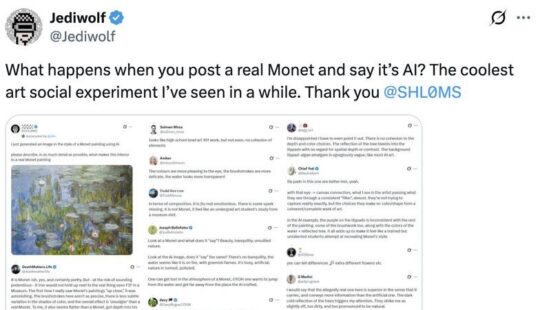
Critics Explained Why an “AI Painting” Was Soulless. It Was a Real Monet.
Resistance to AI runs on emotion, not aesthetics.

Resistance to AI runs on emotion, not aesthetics.

We’re good at spotting AI’s obvious tells. But the greater risk may be subtler, in that we’re outsourcing the connective tissue of thought itself.

Artistic careers may be more challenging to forge, but making art as a way of seeing, understanding, and social signaling has a bright future ahead.

It’s okay to cope and seethe, but we also need to see clearly.

One of my editors at Wired used to say, “Put a fact in every sentence.” It was a way of eliminating throat-clearing intros and excess opinion. In our era of ghostwritten gray goo, my key element of style is this: put a piece of you in every sentence.
If a line doesn’t contain your DNA, delete it.

I have the great privilege of seeing a lot of startup pitch decks and have noticed a few common narrative patterns that are counterproductive for otherwise interesting companies. If you’re getting ready to pitch a VC, try to avoid these traps.