
Critics Explained Why an “AI Painting” Was Soulless. It Was a Real Monet.
Debates about AI are a fascinating mirror to the critics.
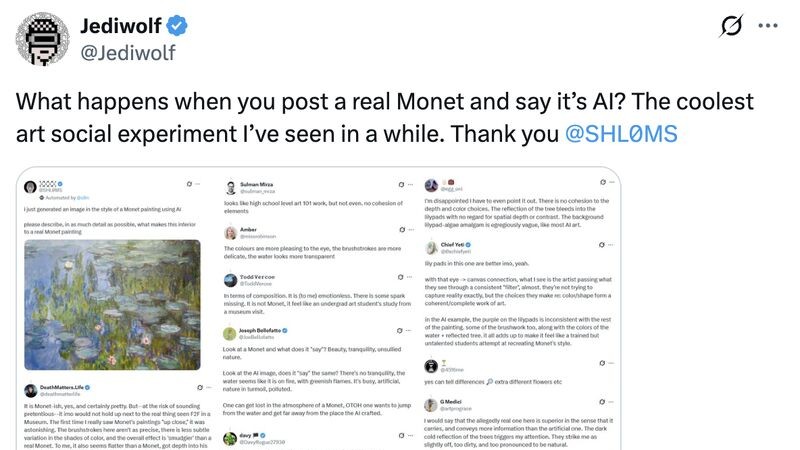
Yesterday, X-user SHL0MS posted a picture of a lesser-known Monet, claimed it was AI-generated, and invited critics to explain why it was inferior to a genuine article. Hundreds obliged with detailed explanations of its shortcomings.
It was flat, they said. It lacked soul, they claimed. It was a painting by Claude Monet, in the end.
I’m not interested in dunking on critics, many of them frustrated creatives, but I’m fascinated by the feelings that animated them.
So far as I can tell:
+ They’re worried about their ability to provide for their families.
+ They’re angry that an education for which they are still servicing loans did not prepare them for this transition.
+ They’re embarrassed that hard-won skills that once signaled expertise now appear commoditized.
+ They’re frustrated that their concerns are falling on ears deafened by the brrrrr of the money printer and the whrrrr of a data center.
+ They’re outraged by the ways bad actors can use these tools to deceive, libel, and defraud.
+ They’re disgusted by the fact that the preferences of the proles are now manifested unquestioningly by pliant artificial artisans and not filtered through their priestly caste’s rites.
+ They’re resentful that forms of craftsmanship (sometimes readily identifiable styles!) that took years to develop can be approximated in seconds.
+ They’re suspicious of the companies building these systems.
+ They’re jealous of newcomers who gain access to capabilities they struggled to obtain.
+ They’re protective of communities, traditions, and standards worth conserving.
+ They’re afraid, rightly, that convenience will overwhelm quality.
+ They’re grieving a world where “mastery” was a durable achievement.
+ They’re disoriented. All this change has happened in under five years.
Mostly, they’re existentially threatened.
Modern meritocracy sorts people based on markers like IQ, symbolic manipulation, recall, and executive function, treating them as proxies for virtue. When machines can do all those things, the sorting mechanism breaks, along with the story people tell about why they deserve what they have.
They’re also spiritually dislocated. Creatives, even those who would disavow the gods or muses as superstition, hold a latent belief that they are conduits for something ineffable that no code could replicate.
This stunt makes it abundantly clear that the resistance to AI is less technical or legalistic and mostly emotional. Trying to win the argument with facts and logic is a losing strategy.
Fear. Pride. Shame. Grief. Resentment.
Emotions don’t make us right, but they do make us human. These emotions, the negative ones in particular, may be our most durable advantage, provided we use them to advance positive aims.
In any case, embracing the messy, meaty reality is probably a better play than praying to the machine spirits. Or praying they’ll go away. I hope so.